
When technicians evaluate battery condition, voltage is often the first value they check. It is easy to measure and useful for identifying obvious abnormalities.
However, voltage is not the complete answer.
A battery module may show normal voltage, but the vehicle may still experience reduced driving range, fast power drop, charging issues, or unstable power output during real use.
This means that normal voltage does not always equal a healthy battery.
To better understand battery condition,
technicians need more than one data point. Internal resistance testing, battery balancing, and charge-discharge maintenance all play an important role in a more complete battery evaluation process.
Normal Voltage Does Not Always Mean a Healthy Battery
Voltage mainly reflects the electrical state of a battery at a specific moment. It can show whether the battery voltage is too high or too low, but it does not fully reflect the battery’s internal condition.
In real repair scenarios, two battery modules may have similar voltage readings, but their actual capacity, internal resistance, and discharge performance may be very different. A battery may look normal when standing still, but problems may appear during charging, discharging, or under load.
If technicians only check voltage, they may miss hidden issues such as internal aging, capacity inconsistency, abnormal internal resistance, or unstable discharge performance.
That is why voltage should be treated as the starting point of battery testing, not the final conclusion.
Internal Resistance Reveals What Voltage Cannot
Internal resistance is an important reference for judging the internal condition of a battery.
It reflects the battery’s internal conductivity and power delivery capability. When internal resistance increases, the battery may have difficulty delivering power efficiently. It may also generate more heat during charging and discharging, lose usable capacity, or show weaker performance under load.
A battery with normal voltage but abnormal internal resistance may still cause fast power drop, weak power output, reduced driving range, or unstable performance during actual use.
Internal resistance testing helps technicians understand whether a battery is only temporarily inconsistent in state of charge, or whether its internal condition has already changed. This makes battery evaluation more accurate and gives technicians a stronger basis for maintenance, balancing, or replacement decisions.
Battery Balancing Helps Improve Usable Capacity and Driving Range
A battery pack is made up of multiple cells or modules. The overall performance of the pack is often affected by the weakest cell or module. If the capacity or voltage between cells is inconsistent, the available capacity of the whole battery pack may be limited.
In some cases, the battery is not completely failed. The issue may come from capacity imbalance, voltage inconsistency, or uneven battery state.
Battery balancing helps improve consistency across the battery pack. After charge-discharge maintenance and balancing, the battery pack may achieve better usable capacity and more stable performance. This can help improve driving range and support better vehicle operation.
For technicians, battery balancing is not only a maintenance step. It is also a way to improve battery service quality and provide customers with more professional repair recommendations.
How BEC2440 Supports a More Complete Battery Testing Workflow
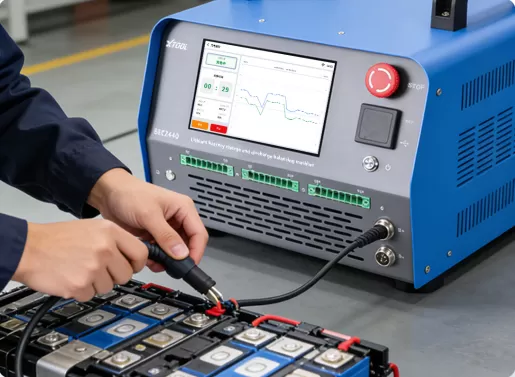
XTOOL BEC2440 is designed to help technicians move beyond voltage-only testing and build a more complete battery maintenance workflow.
When voltage alone is not enough,
BEC2440 supports internal resistance testing to provide another key reference for battery condition evaluation.
When battery consistency becomes a problem,
BEC2440 supports 24-channel battery balancing, helping technicians improve consistency across cells or modules.
When workshop efficiency matters,
BEC2440 supports 40A high-current charging and 20A discharging, helping technicians complete charge-discharge maintenance more efficiently.
When safety is critical,
BEC2440 provides multiple protection functions, helping make battery maintenance more controlled and stable.
Together, these functions help technicians move from simple testing to a more complete workflow of testing, maintenance, balancing, and verification.
More Accurate Testing, Better Maintenance Decisions
The value of battery maintenance tools is not only that they measure more data. More importantly, they help workshops make better maintenance decisions.
By combining voltage reference, internal resistance testing, charge-discharge maintenance, and battery balancing, technicians can better understand battery condition and avoid relying on a single value.
For repair shops, this can help reduce misjudgment caused by voltage-only testing, improve battery maintenance results, and support the expansion ofEV battery service.
BEC2440 helps workshops move from simple battery checking to a more complete service process that includes testing, maintenance, balancing, and verification.
Conclusion: Look Beyond Voltage
Voltage is important, but it is only one part of battery testing. A normal voltage reading does not always mean that the internal battery condition is stable.
To evaluate battery health more accurately, technicians need to look at internal resistance, battery consistency, charge-discharge performance, and maintenance results.
With internal resistance testing, 24-channel battery balancing, 40A high-current charging, 20A discharging, and multiple safety protections, XTOOL BEC2440 provides workshops with a more complete solution forEV battery maintenance.
For repair shops entering the EV service market, it is a practical tool for building stronger battery testing and maintenance capability.